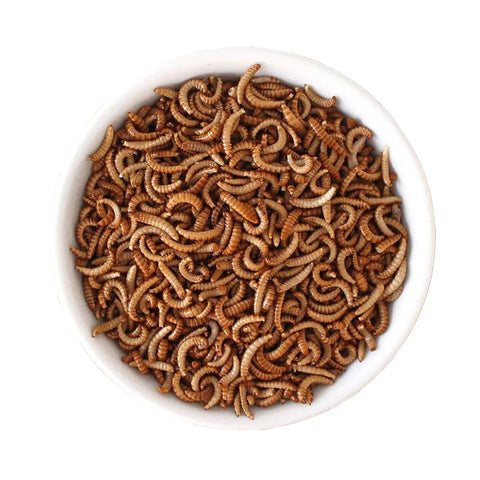
Buffalo worms are the smallest, mildest and most beginner-friendly of the EU's four edible insects, and the one most people have never heard of. Here is what they are, how they differ from mealworms, what is in them and how to use them.
What a buffalo worm is
A buffalo worm is the larva of the lesser mealworm beetle (Alphitobius diaperinus). It was authorised as a novel food in the EU in 2023, frozen, dried, paste and powder, after a safety assessment by EFSA. The name has nothing to do with buffaloes; it is a trade name that stuck because "lesser mealworm" does not sell. In German they are Buffalowürmer, in Dutch buffalowormen, and the Netherlands is where most European production started.
At Sens we sell dried buffalo worms, unseasoned, in value packs for cooking.
Buffalo worms versus mealworms
They are cousins, not the same animal. The regular mealworm is the larva of Tenebrio molitor, about 2 to 3 cm long. The buffalo worm is roughly half that size, 1 to 1.5 cm, with a thinner skin.
- Taste: buffalo worms are milder and more neutral, with a faint nutty note. Mealworms taste more like roasted peanuts. Crickets are the strongest of the three.
- Texture: smaller and crisper. They disappear into dishes more easily, which is why cooks like them.
- Nutrition: very similar. Both are around 50 to 55 % protein and 25 to 30 % fat on a dry basis. Buffalo worms have slightly more protein and slightly less fat than mealworms in most analyses.
- Price: buffalo worms grow faster and denser, so they are usually the cheaper insect per kilo.
If you want the most forgiving insect to put in front of someone who has never tried one, this is it. If you want crunch and flavour on their own, seasoned crickets win.
What is in 100 g of dried buffalo worms
- Protein: around 50 to 55 g, complete, with all nine essential amino acids.
- Fat: around 25 to 30 g, mostly unsaturated, with a reasonable omega-3 to omega-6 ratio.
- Chitin: around 5 g, the prebiotic fibre from the exoskeleton.
- Iron, zinc, magnesium, vitamin B12.
Compared with crickets (60 to 70 % protein) they bring more energy and less protein per gram, which makes them better suited to cooking than to a protein shake. The full species comparison is in our guide to edible insects, and the detail on insect flour in this article.
How buffalo worms are farmed
In stacked crates in climate-controlled rooms, on a diet of grain by-products such as wheat bran and vegetable scraps. They reach harvest size in about six weeks, are chilled into dormancy, then blanched and dried. Being cold-blooded, they convert feed into body mass with a fraction of the land, water and emissions of cattle. EU farms work under the same food law as any other animal production and test every batch for microbes and heavy metals.
Is it safe to eat buffalo worms?
Yes, with the allergy exception that applies to all insects: they share the protein tropomyosin with crustaceans and house dust mites. If you are allergic to shrimp, crab or dust mites, you may react to buffalo worms too. Every Sens pack carries that warning.
How to cook with buffalo worms
- Toast and sprinkle. Two minutes in a dry pan with salt, then over salads, soups, rice or scrambled eggs. Their size makes them a natural topping.
- Stir-fry. Add them in the last minute with garlic and soy; they stay crisp.
- Bake them in. Whole in granola or savoury crackers, or ground into a flour and swapped for 10 to 20 % of regular flour in bread and cookies.
- Blend them. Ground buffalo worms disappear into bolognese, meatballs and burger patties, lifting protein without changing taste.
Store dry and closed; unopened they keep for a year. Want to try insects without cooking first? The tasting bundle of seasoned crickets and mealworms is the easy start.